
How it Works
So where does better growth begin?
It starts with better judgement.
Knowing which tactics deserve your time in the first place.
I’ve just spent the last few minutes explaining why there isn’t a one-size-fits-all answer.
Now I’m going to show you how I go about finding one.
That’s what I’ve been helping agencies do for the last twenty years.
Along the way, I’ve seen strategies, channels and playbooks come and go.
Some worked. Some didn’t. Some worked brilliantly… until they didn’t anymore.
But one thing was constant.
Of the hundreds of agencies I’ve worked with, the ones that grew consistently weren’t following more advice.
They were simply better at turning advice into decisions.
Turning general into specific. Turning broad into bespoke. Turning ideas into action. Turning noise into clarity.
That’s what this process is for.
Not to tell every agency to do the same thing. But to help every agency figure out what’s right for theirs.
See what's really happening.
People sometimes imagine strategy is a bit like an oracle.
You arrive with a commercial problem.
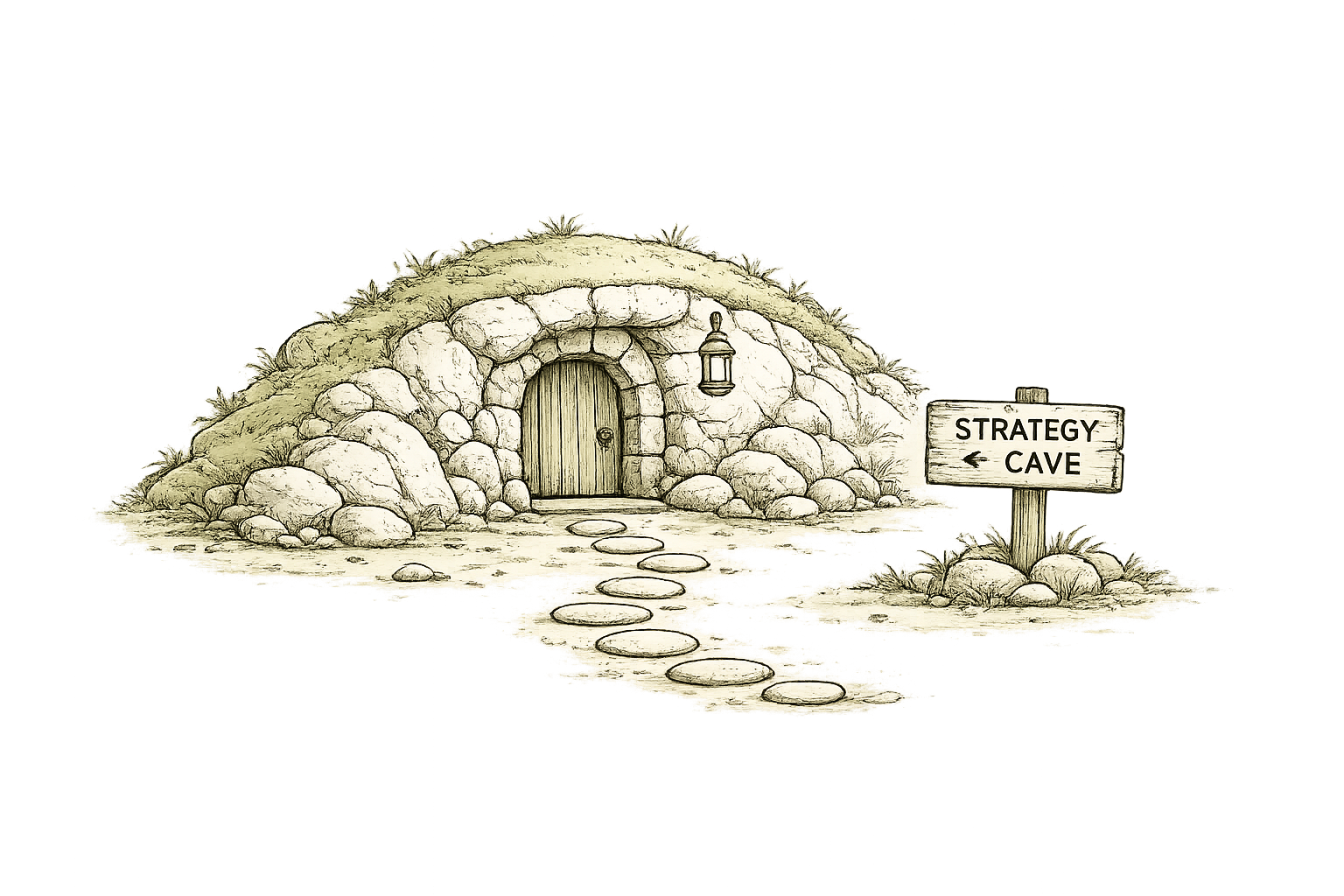
I disappear into a the strategy cave.
Twenty minutes later, I emerge with The Answer™.
Sadly, that’s not how it works.
Good strategy asks questions in two directions.
Inwards, to understand your agency.
Outwards, to understand the market around it.
The best decisions happen where those two perspectives meet.
Ways we strengthen this
- Commercial diagnostics
- Positioning and proposition
- Audience and opportunity mapping
- Stakeholder insight
- Competitive perspective
- Growth planning
Choose what matters most.
You’ve asked the questions. You’ve gathered the evidence.
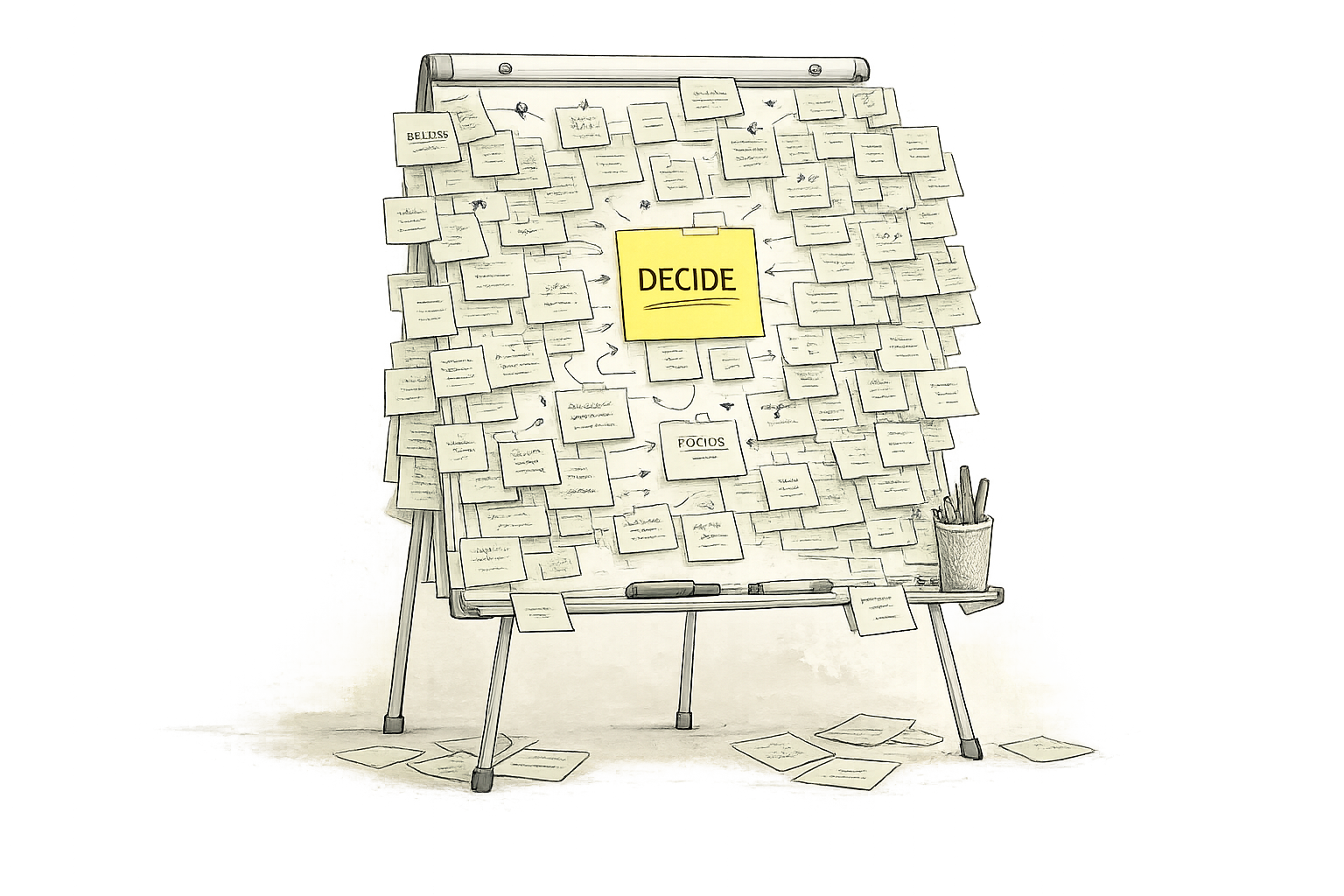
Somewhere, a whiteboard is groaning under the weight of colour-coded Post-it notes.
Brilliant.
Now comes the hardest question of them all. A decision that will shape everything that follows:
How will your agency actually grow over the next 6 to 12 months?
Everything else is helping you answer that.
- Where will value actually be created?
- What do we want to become known for?
- Which commercial bets deserve backing?
- What are we deliberately choosing not to do?
- Why do we believe this will work?
Now you know what you are building.
Ways we strengthen this
- Making better commercial decisions
- Prioritising what matters most
- Evaluating opportunities
- Aligning the right people
- Planning ahead
- Turning decisions into action
Create stronger foundations.
Right.
You’ve made some decisions. You know where you’re heading. Time to go and do it, right?
Well… not quite.
Your strategy is only as strong as the evidence behind it.
Sooner or later, someone will say:
“Interesting. Can you show me?”
Those bold claims you’re making.
“The only agency who…”
“The best people to help…”
“The smarter way to…”
They need something behind them.
The territory you’ve chosen to own needs proof.
Your positioning needs substance.
Your story needs evidence.
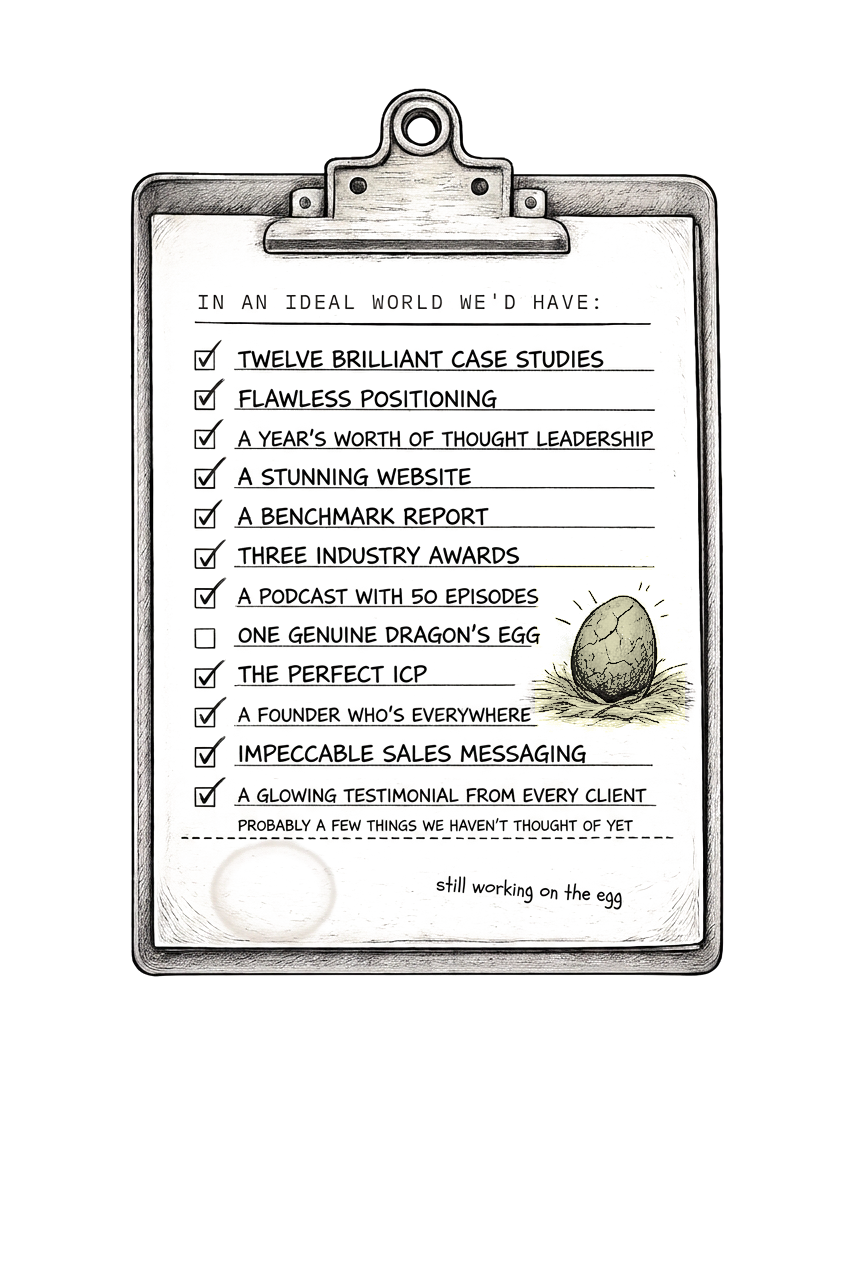
Now, in an ideal world, we’d build everything before speaking to a single prospect.
We don’t live in that world.
Agencies still need momentum.
So we identify the handful of things that create immediate credibility, get those into market, and keep building everything else as we go.
Ways we strengthen this
- Positioning
- Content
- Case studies
- Website
- Founder presence
- Proof points & credibility
- Measurement & reporting
- Tools & assets
Earn attention naturally.
Every agency eventually arrives at the same challenge.
You’ve done the thinking. Made the decisions. Built something worth believing in.
Now comes the difficult part: earning someone’s attention.
The principle I’ve come back to, again and again, is surprisingly simple.
Introduce value, not yourself.
People don’t like feeling like the next step in somebody else’s sales process.
I’ve found the best outreach rarely feels like outreach. It feels useful.
Whether that’s an insight, a fresh perspective, a thoughtful introduction or a piece of research.
Or, simply helping somebody think differently.
No matter the channel, creating something genuinely useful consistently outperforms forcing something salesy.
Collaborative. Editorial. Insight-driven.
Share something you genuinely believe another person will find relevant, timely, and most of all, useful.
Channels, tactics and algorithms all change.
Throughout it all though, I’ve found this principle survives every trend.
People respond better when you give them something useful before asking for something in return.

Ways we strengthen this
- Founder visibility
- Editorial content
- Insight-led outreach
- Strategic familiarity
- Partnerships
- Relationship building
- Outreach messaging
- Commercial campaigns
Keep getting better.
You’ve started putting your ideas, evidence and point of view into the world.
And then something really interesting starts to happen.
The market starts talking back. Suddenly, you have access to entirely new sources of insight.
You’re no longer relying on desk research, surveys or internal workshops.
You’re learning through conversations. Through objections. Through introductions. Sometimes… through silence. Through the opportunities you win, and the ones you don’t.
Every interaction creates new evidence.
The goal now is to understand how reality is responding to your strategy.
That’s where better judgement comes from.
Asking what happened.
Why it happened.
And deciding what to do next.

We notice:
- Conversations
- Buying signals
- Introductions
- Competitor moves
- Market shifts
- Content performance
- Win / loss patterns
- Founder observations
…and gradually build better judgement about what to do next.
What I can help with
Positioning
Clarify what you do, who it’s for and why it matters.
Growth strategy
Turn commercial ambition into a practical plan.
Business development
Build better routes to the right opportunities, including hands-on outbound execution.
Content & visibility
Make your thinking visible to the people who matter.
Sales enablement
Give you the tools to turn opportunity into action.

As an aside…
This page covers the behavioural side of growth. Things I’ve Noticed is where I collect the commercial observations that refused to leave me alone. Why I think some agencies suffer from Premature Amplification. Why Manufactured Urgency rarely works. Why Pipeline Theatre is a real menace. How two awkwardly glued together words make growth easier. Along with whatever else I’ve been overthinking recently.