The Big Stuff
The Vending Machine Problem
Why brute force doesn’t always get you the Mars Bar you wanted
5 mins
There are few things in life more endearingly human than a grown adult trying to negotiate with a rogue vending machine.
The first button press is polite. A gentle tap on E6.
The second is hopeful. A slightly firmer double prod.
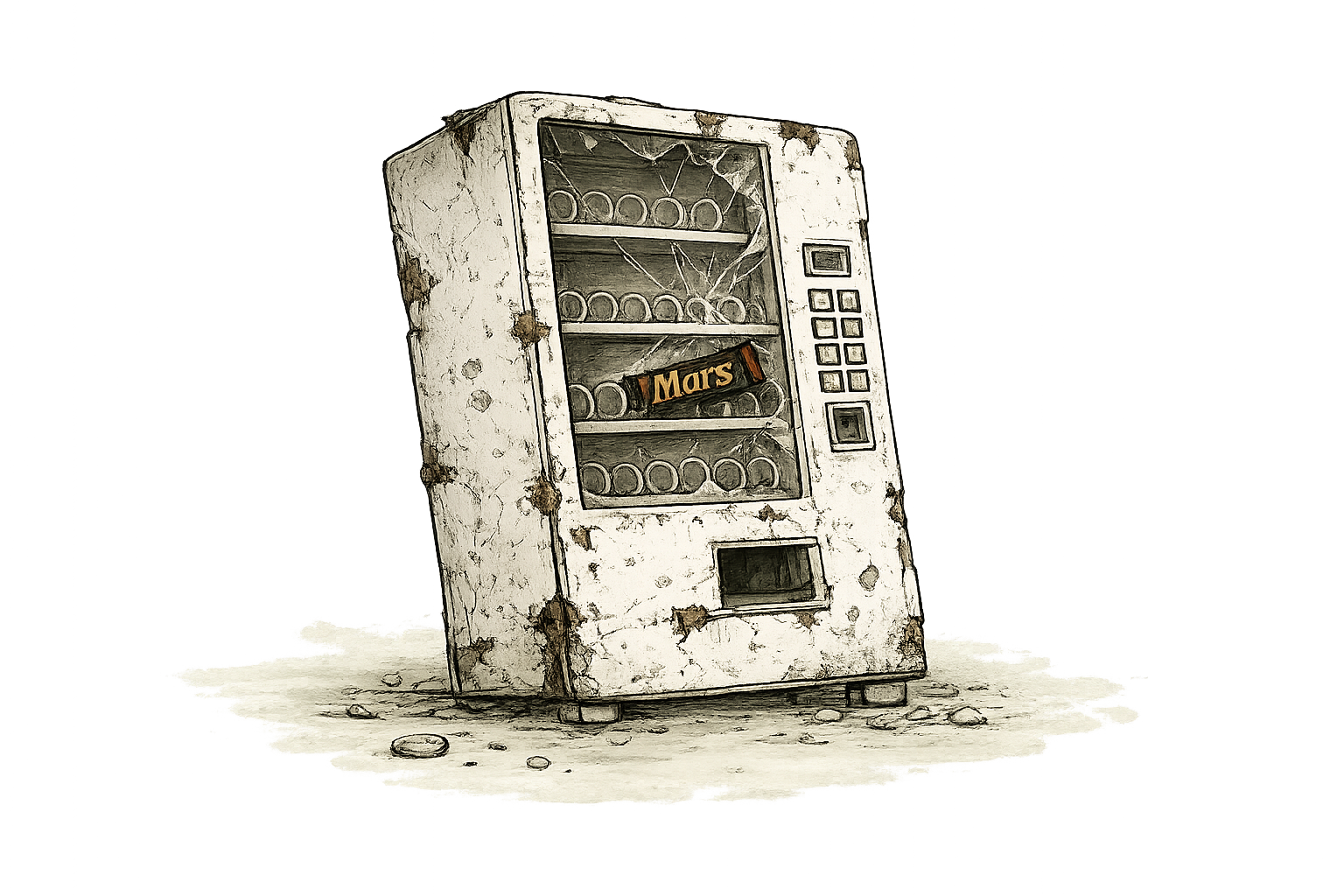
By the fifth or sixth attempt, we're rocking forty kilos of steel backwards and forwards like it owes us money.
I sometimes wonder whether commercial growth works the same way.
Failure has a funny way of narrowing our imagination. It's surprisingly difficult, genuinely difficult, to step back and ask whether we're solving the right problem. Instead, we become increasingly committed to the current solution. We don't widen our search for answers. We double down on the one we've already chosen.
Put another way, when something doesn't work, our natural instinct isn't to question the approach. It's to prescribe more of it.
No replies? Better send more emails.
Weak pipeline? More outreach.
Quiet LinkedIn? More posts.
Low event attendance? More invitations.
Website not converting? Add another CTA.
More. Louder. Harder. Faster.
The problem usually isn't a lack of effort. It's that our range of possible answers has quietly collapsed to one. Do more of the thing we're already doing. Brute force it. Intensity is often what strategy looks like when strategy is missing.
Psychologists call this escalation of commitment. The more we've invested in a course of action, the harder it becomes to abandon it, even when the evidence is pointing elsewhere. Economists arrive at much the same destination through the sunk cost fallacy. Once we've invested time, money or ego into something, we feel oddly compelled to keep investing, simply because we've already come this far.
Different disciplines. Same awkwardly human behaviour.
The first casualty of frustration is curiosity. I read that somewhere. Possibly on a fortune cookie. Either way, it fits. We stop asking whether we're solving the right problem and start asking how to do more of the thing we're already doing.
Of course we do. I do it too. It's a deeply human response.
Years ago I remember staring at disappointing webinar registrations, for something we had spent months planning. We could have rewritten the title, changed the proposition, found a stronger speaker, rethought the format, or even admitted we'd started with the wrong premise.
Instead, the conversation quickly became, "Let's just widen the targeting."
It felt productive. It felt like progress. It was certainly easier than reopening the strategy.
But we'd stopped exploring. We'd started escalating. And the market doesn't care how hard we're pushing if we're pushing in the wrong direction.
I've seen agencies send more emails when the real problem was that none of their target audience saw any value in the audit they were offering. I've seen businesses redesign perfectly good websites when the issue was unclear positioning. I've watched founders push to produce even more content when what they really needed was a more distinctive point of view.
In every case, the breakthrough came from changing the question rather than increasing the effort.
Agency growth can sometimes feel like the corporate equivalent of vigorously shaking a vending machine instead of checking whether you've got the right coins.
Lots of effort.
Increasingly inventive techniques.
Growing confidence that this shove will be the one.
Still no Mars Bar.
The trick, eventually, is recognising that the next shove probably isn't the one that's going to do it.
There are few things in life more endearingly human than a grown adult trying to negotiate with a rogue vending machine.
The first button press is polite. A gentle tap on E6.
The second is hopeful. A slightly firmer double prod.
By the fifth or sixth attempt, we're rocking forty kilos of steel backwards and forwards like it owes us money.
I sometimes wonder whether commercial growth works the same way.
Failure has a funny way of narrowing our imagination. It's surprisingly difficult, genuinely difficult, to step back and ask whether we're solving the right problem. Instead, we become increasingly committed to the current solution. We don't widen our search for answers. We double down on the one we've already chosen.
Put another way, when something doesn't work, our natural instinct isn't to question the approach. It's to prescribe more of it.
No replies? Better send more emails.
Weak pipeline? More outreach.
Quiet LinkedIn? More posts.
Low event attendance? More invitations.
Website not converting? Add another CTA.
More. Louder. Harder. Faster.
The problem usually isn't a lack of effort. It's that our range of possible answers has quietly collapsed to one. Do more of the thing we're already doing. Brute force it. Intensity is often what strategy looks like when strategy is missing.
Psychologists call this escalation of commitment. The more we've invested in a course of action, the harder it becomes to abandon it, even when the evidence is pointing elsewhere. Economists arrive at much the same destination through the sunk cost fallacy. Once we've invested time, money or ego into something, we feel oddly compelled to keep investing, simply because we've already come this far.
Different disciplines. Same awkwardly human behaviour.
The first casualty of frustration is curiosity. I read that somewhere. Possibly on a fortune cookie. Either way, it fits. We stop asking whether we're solving the right problem and start asking how to do more of the thing we're already doing.
Of course we do. I do it too. It's a deeply human response.
Years ago I remember staring at disappointing webinar registrations, for something we had spent months planning. We could have rewritten the title, changed the proposition, found a stronger speaker, rethought the format, or even admitted we'd started with the wrong premise.
Instead, the conversation quickly became, "Let's just widen the targeting."
It felt productive. It felt like progress. It was certainly easier than reopening the strategy.
But we'd stopped exploring. We'd started escalating. And the market doesn't care how hard we're pushing if we're pushing in the wrong direction.
I've seen agencies send more emails when the real problem was that none of their target audience saw any value in the audit they were offering. I've seen businesses redesign perfectly good websites when the issue was unclear positioning. I've watched founders push to produce even more content when what they really needed was a more distinctive point of view.
In every case, the breakthrough came from changing the question rather than increasing the effort.
Agency growth can sometimes feel like the corporate equivalent of vigorously shaking a vending machine instead of checking whether you've got the right coins.
Lots of effort.
Increasingly inventive techniques.
Growing confidence that this shove will be the one.
Still no Mars Bar.
The trick, eventually, is recognising that the next shove probably isn't the one that's going to do it.