The Big Stuff
Shelf Life
Rancid milk, withered growth tactics and the power of rule breaking
10 mins
Lemon and pepper take this but… I strongly believe every competitive advantage has an expiry date.
Not a precise one, admittedly.
Commercial ideas aren't quite like milk. They don't wake up one Tuesday morning and suddenly become lumpy, rancid and dangerous to use.
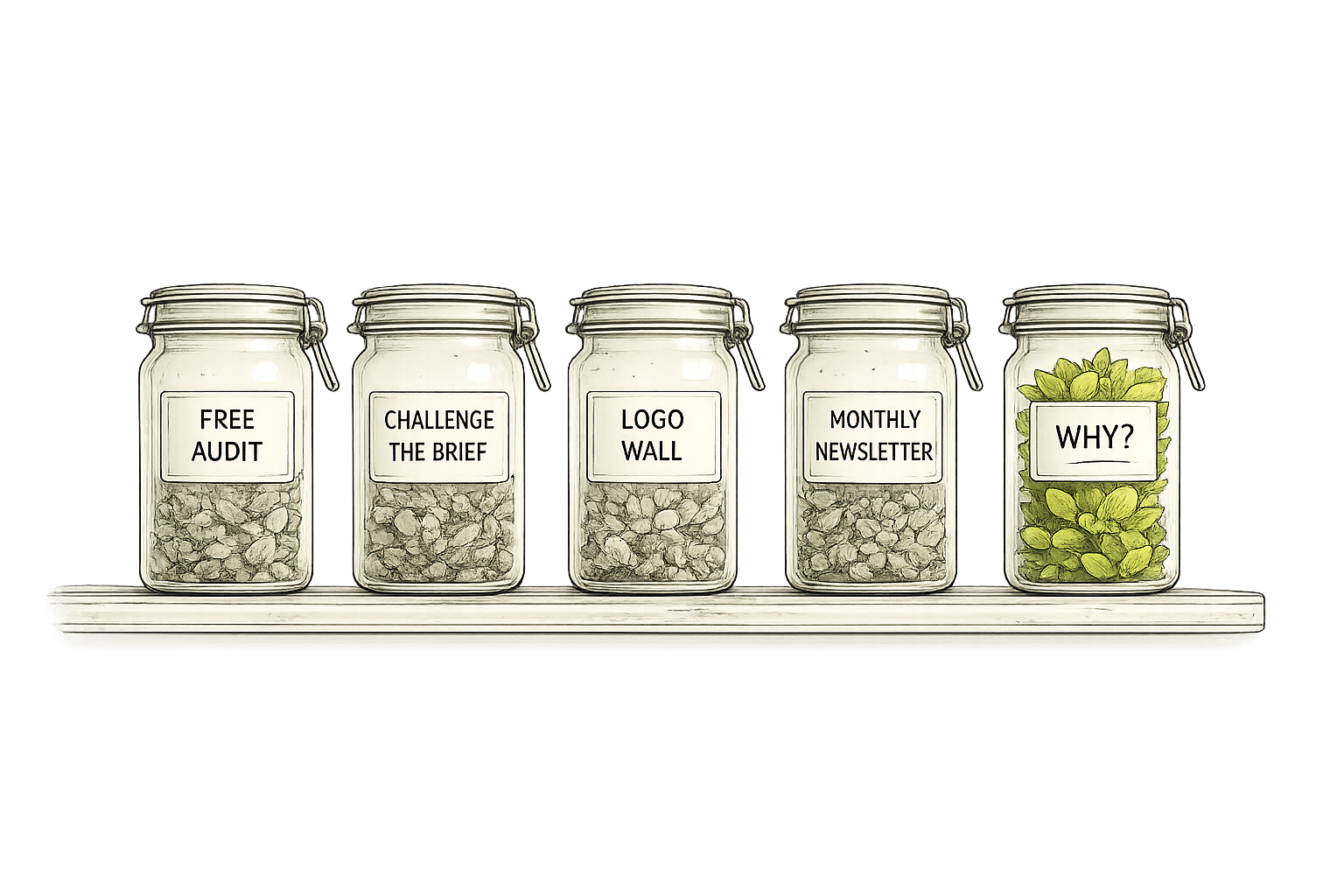
I guess a better analogy would be that they're probably closer to the dried herbs we've all got lurking at the back of the cupboard.
Still perfectly usable. Just... not nearly as potent as they once were.
That's what makes them so difficult to spot.
Most growth tactics don't fail dramatically. It's more that they lose their tang, while continuing to feel perfectly sensible. Until one day you realise you've been relying on something everybody else adopted years ago.
That's the nature of competition, right? Every competitive advantage eventually becomes utter table stakes.
Let me put this another way: Every best practice started life because somebody broke the rules.
The first agency to ever offer a free audit probably stood out.
The first, in a pitch meeting to utter the most wallpaper sentence in marketing: "we challenge the brief".
The first to publish genuinely useful thinking… instead of a thinly veiled case study wrapper, masquerading as thought leadership
The first founders to cotton onto the power of building a personal brand.
The first to… well, you get the idea.
The problem isn't that these were bad ideas. Quite the opposite. They were so good that everyone ended up copying them. Soon they become overplayed, overdone and a bit beige.
In a way, and strangely enough, their success is often what shortens the shelf life.
I should probably admit I've helped accelerate that cycle myself.
Over the years, whenever we found a tactic that genuinely outperformed the rest, we'd naturally look to scale it. One successful campaign became ten. Ten became fifty. Eventually it was being rolled out across hundreds of clients. Alexa, what does ubiquitous mean?
Let me be clear: That wasn't the wrong decision. It would've been strange / mad not to.
It's just ironic that every time we scaled a successful idea, we nudged it one step closer to becoming ordinary.
That's how markets evolve. The winners get copied. The copies become common. Common becomes expected. Then someone, somewhere, breaks the rules again.
"Just wanted to bump this..." No. You wanted another chance to be read. Those aren't the same thing.
The best follow-ups don't remind people you exist. They give people a fresh reason to care.
"Fancy a free audit?" There was a time when that genuinely felt generous. Then everyone started offering one. Somewhere along the way, the audit became the product instead of the introduction. It didn't stop being useful. It just stopped being distinctive.
"We've worked with..." That's nice. What did you learn? The logos prove you've been busy but the thinking proves you'll be useful.
"We're a full-service agency." Gestures vaguely at the other 30,000 full-service agencies... Categories help people understand what you do but they don't really explain why anyone should choose you.
Monthly newsletters. Some arrive because somebody had something interesting to say. Others arrive because it's the first Tuesday. One earns attention, whereas the other simply keeps a promise made to a content calendar.
The proposal. Every proposal promises to challenge the brief. After a while, it starts to feel like New Business Bingo. The irony is that genuinely challenging a brief doesn't often begin with writing a better proposal, but by asking better questions.
None of these are bad ideas. That's the point. Every one of them worked. Every one of them probably still works, to some extent.
They're just no longer carrying the weight they once did. Because the thing that made them effective was never the tactic itself.
It was the human principle underneath.
The audit felt generous.
The follow-up added value.
The case study demonstrated credibility.
The challenge showed original thinking.
The tactic was simply one expression of a much deeper idea. That's the bit worth protecting. Not the recipe but the ingredient.
There's a temptation, when something starts losing its impact, to look for the next shiny tactic.
I don't think that's the answer. And don't get me wrong, I loves me a shiny new tactic. I've built a career on creating them, roadtesting them, scaling them.
It's just that I think there's a better, much simpler question to pose to ourselves.
"What made this work in the first place?"
Because if you understand that, you'll probably invent something better than copying whatever everybody else is doing next.
Shelf life isn't a reason to throw everything out every six months.
It's simply a reminder to keep opening the cupboard. Every now and then, pick something up, dust it off, and ask yourself:
If we were introducing this today, would it still earn its place on the shelf?
If the answer is no, don't mourn the tactic. Go back to the insight that created it.
That's where the next competitive advantage usually begins.
Lemon and pepper take this but… I strongly believe every competitive advantage has an expiry date.
Not a precise one, admittedly.
Commercial ideas aren't quite like milk. They don't wake up one Tuesday morning and suddenly become lumpy, rancid and dangerous to use.
I guess a better analogy would be that they're probably closer to the dried herbs we've all got lurking at the back of the cupboard.
Still perfectly usable. Just... not nearly as potent as they once were.
That's what makes them so difficult to spot.
Most growth tactics don't fail dramatically. It's more that they lose their tang, while continuing to feel perfectly sensible. Until one day you realise you've been relying on something everybody else adopted years ago.
That's the nature of competition, right? Every competitive advantage eventually becomes utter table stakes.
Let me put this another way: Every best practice started life because somebody broke the rules.
The first agency to ever offer a free audit probably stood out.
The first, in a pitch meeting to utter the most wallpaper sentence in marketing: "we challenge the brief".
The first to publish genuinely useful thinking… instead of a thinly veiled case study wrapper, masquerading as thought leadership
The first founders to cotton onto the power of building a personal brand.
The first to… well, you get the idea.
The problem isn't that these were bad ideas. Quite the opposite. They were so good that everyone ended up copying them. Soon they become overplayed, overdone and a bit beige.
In a way, and strangely enough, their success is often what shortens the shelf life.
I should probably admit I've helped accelerate that cycle myself.
Over the years, whenever we found a tactic that genuinely outperformed the rest, we'd naturally look to scale it. One successful campaign became ten. Ten became fifty. Eventually it was being rolled out across hundreds of clients. Alexa, what does ubiquitous mean?
Let me be clear: That wasn't the wrong decision. It would've been strange / mad not to.
It's just ironic that every time we scaled a successful idea, we nudged it one step closer to becoming ordinary.
That's how markets evolve. The winners get copied. The copies become common. Common becomes expected. Then someone, somewhere, breaks the rules again.
"Just wanted to bump this..." No. You wanted another chance to be read. Those aren't the same thing.
The best follow-ups don't remind people you exist. They give people a fresh reason to care.
"Fancy a free audit?" There was a time when that genuinely felt generous. Then everyone started offering one. Somewhere along the way, the audit became the product instead of the introduction. It didn't stop being useful. It just stopped being distinctive.
"We've worked with..." That's nice. What did you learn? The logos prove you've been busy but the thinking proves you'll be useful.
"We're a full-service agency." Gestures vaguely at the other 30,000 full-service agencies... Categories help people understand what you do but they don't really explain why anyone should choose you.
Monthly newsletters. Some arrive because somebody had something interesting to say. Others arrive because it's the first Tuesday. One earns attention, whereas the other simply keeps a promise made to a content calendar.
The proposal. Every proposal promises to challenge the brief. After a while, it starts to feel like New Business Bingo. The irony is that genuinely challenging a brief doesn't often begin with writing a better proposal, but by asking better questions.
None of these are bad ideas. That's the point. Every one of them worked. Every one of them probably still works, to some extent.
They're just no longer carrying the weight they once did. Because the thing that made them effective was never the tactic itself.
It was the human principle underneath.
The audit felt generous.
The follow-up added value.
The case study demonstrated credibility.
The challenge showed original thinking.
The tactic was simply one expression of a much deeper idea. That's the bit worth protecting. Not the recipe but the ingredient.
There's a temptation, when something starts losing its impact, to look for the next shiny tactic.
I don't think that's the answer. And don't get me wrong, I loves me a shiny new tactic. I've built a career on creating them, roadtesting them, scaling them.
It's just that I think there's a better, much simpler question to pose to ourselves.
"What made this work in the first place?"
Because if you understand that, you'll probably invent something better than copying whatever everybody else is doing next.
Shelf life isn't a reason to throw everything out every six months.
It's simply a reminder to keep opening the cupboard. Every now and then, pick something up, dust it off, and ask yourself:
If we were introducing this today, would it still earn its place on the shelf?
If the answer is no, don't mourn the tactic. Go back to the insight that created it.
That's where the next competitive advantage usually begins.