
Smaller rabbit holes
Walls of text
Educational flexes with a hint of life lessons.
2 mins
This might be biased of me… I have a GSCE, an A level, a degree and half a finished Masters in English but… Writing is easy.
Especially now. "Chat, transform my ramblings into a coherent argument with proper sentence structure. Make no mistakes."
See? Easy.
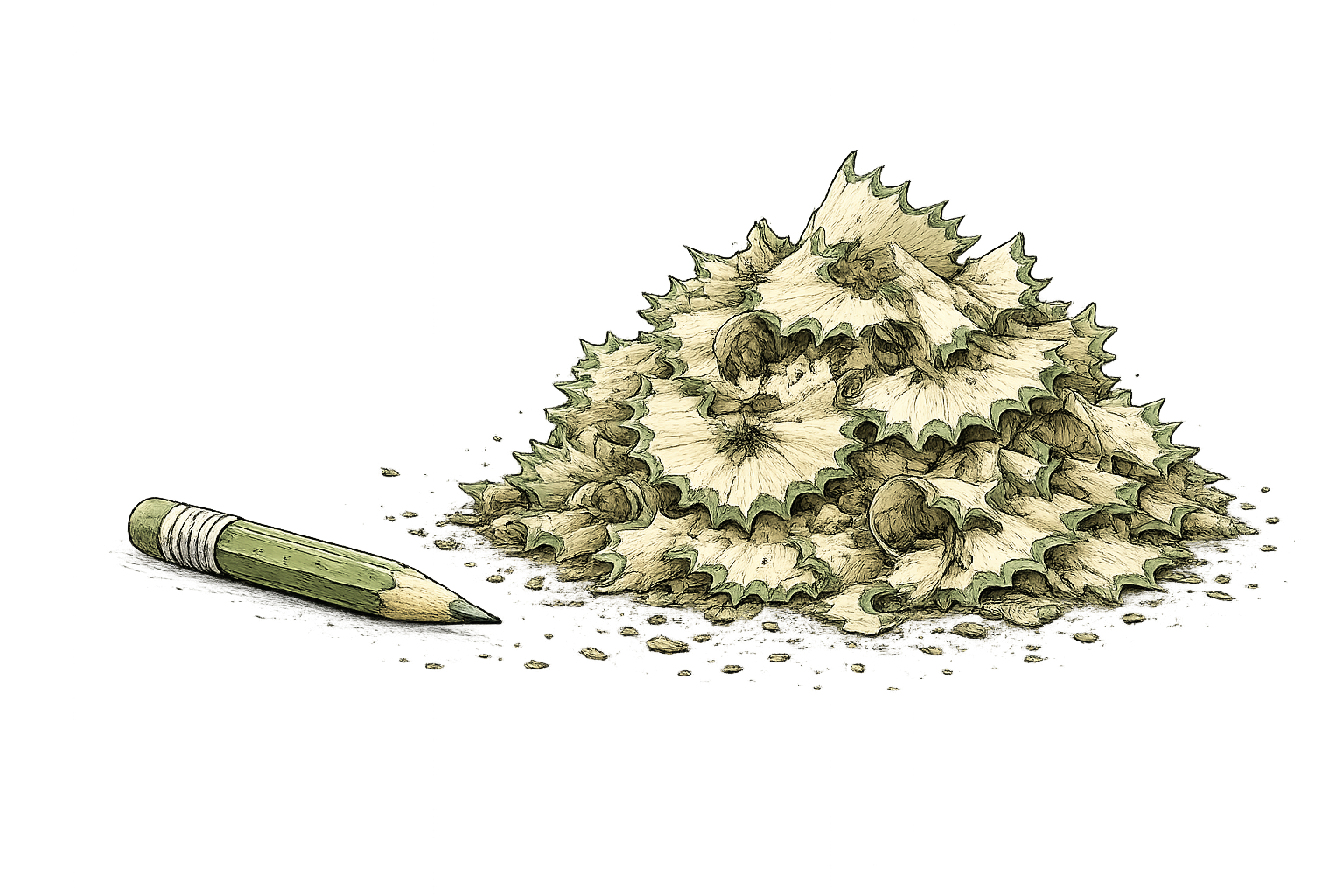
But… working out what to cut? That's hard.
And I don't think that's just true of cold emails. It's true of proposals, presentations, websites, LinkedIn posts (and, if I'm honest, this article before I edited it.)
When I first started in new business, I barely wrote cold emails at all.
I was an arrogant pup. I'd happily spend all day on the phone, cold calling. You can bet I was smiling and dialling. If somebody said, "Send me an email," I'd think, Nah. I'll just ring someone else.
Then I noticed something.
Every morning, the people sitting around me would open their inboxes to find replies from emails they'd sent the day before. Leads and opportunities had appeared overnight while they'd been asleep.
Meanwhile, I'd been relying on one smiley dially channel, that took effort.
So, I figured I should probably learn this whole email thing.
My first proper attempt was... enthusiastic.
I'd had a great conversation with a prospect, sat down to write the follow-up and decided to include absolutely everything I could possibly think of.
Who we were. What we did. Every service. Every capability. Every reason they should work with us. I think I listed every single one of their clients. That they'd ever worked with. Maybe the fact that they had an office dog.
It was less "follow-up email" and more "My agency is Very Good and would like to work with you. In this essay I will…"
I think I remember scrolling up at the end and thinking… ok. I think that's covered everything. Everything being the utterly right word but also the utterly wrong thing to do.
Funny enough… they never replied.
It took me far, far, far longer than it should have to realise that the problem wasn't the email. I maintain - to this day - that there were good salient points in there (I'd also like to think that somewhere that email is still pinned to a notice board and has gone down in folklore in the Guylian marketing teams' office as a symbol of everything that is wrong with the Western world).
However, it was based on one completely flawed misconception: that more information equals more persuasion.
I've never really found that to be true. Attention is finite and every additional sentence has to earn the right to exist. That's much harder than simply writing another one.
One of my favourite copywriting exercises is brutally simple.
Write the email.
Then try deleting half of it.
Most people physically recoil at the suggestion of murdering their darlings. "But they'll miss the important context."
Will they? Or have you confused 'everything you could say' with 'everything you need to say'?
I've been helping agencies write outreach for nearly two decades. I've never once looked at a draft and thought: "You know what this needs? Another three paragraphs."
The irony is that confidence often sounds shorter.
People who know exactly what they're trying to communicate rarely need six hundred words to get there.
They're comfortable leaving things unsaid, and creating curiosity. Trusting the reader to join the dots.
That doesn't mean every email should be two sentences (although I've often tried - and failed - to nail the new business haiku.
It just means every sentence should have a job.
If it isn't introducing an idea, creating interest, demonstrating understanding or moving the conversation forward...
...it's probably just enjoying the company of the other words.
Writing is easy. Editing is commercial.
This might be biased of me… I have a GSCE, an A level, a degree and half a finished Masters in English but… Writing is easy.
Especially now. "Chat, transform my ramblings into a coherent argument with proper sentence structure. Make no mistakes."
See? Easy.
But… working out what to cut? That's hard.
And I don't think that's just true of cold emails. It's true of proposals, presentations, websites, LinkedIn posts (and, if I'm honest, this article before I edited it.)
When I first started in new business, I barely wrote cold emails at all.
I was an arrogant pup. I'd happily spend all day on the phone, cold calling. You can bet I was smiling and dialling. If somebody said, "Send me an email," I'd think, Nah. I'll just ring someone else.
Then I noticed something.
Every morning, the people sitting around me would open their inboxes to find replies from emails they'd sent the day before. Leads and opportunities had appeared overnight while they'd been asleep.
Meanwhile, I'd been relying on one smiley dially channel, that took effort.
So, I figured I should probably learn this whole email thing.
My first proper attempt was... enthusiastic.
I'd had a great conversation with a prospect, sat down to write the follow-up and decided to include absolutely everything I could possibly think of.
Who we were. What we did. Every service. Every capability. Every reason they should work with us. I think I listed every single one of their clients. That they'd ever worked with. Maybe the fact that they had an office dog.
It was less "follow-up email" and more "My agency is Very Good and would like to work with you. In this essay I will…"
I think I remember scrolling up at the end and thinking… ok. I think that's covered everything. Everything being the utterly right word but also the utterly wrong thing to do.
Funny enough… they never replied.
It took me far, far, far longer than it should have to realise that the problem wasn't the email. I maintain - to this day - that there were good salient points in there (I'd also like to think that somewhere that email is still pinned to a notice board and has gone down in folklore in the Guylian marketing teams' office as a symbol of everything that is wrong with the Western world).
However, it was based on one completely flawed misconception: that more information equals more persuasion.
I've never really found that to be true. Attention is finite and every additional sentence has to earn the right to exist. That's much harder than simply writing another one.
One of my favourite copywriting exercises is brutally simple.
Write the email.
Then try deleting half of it.
Most people physically recoil at the suggestion of murdering their darlings. "But they'll miss the important context."
Will they? Or have you confused 'everything you could say' with 'everything you need to say'?
I've been helping agencies write outreach for nearly two decades. I've never once looked at a draft and thought: "You know what this needs? Another three paragraphs."
The irony is that confidence often sounds shorter.
People who know exactly what they're trying to communicate rarely need six hundred words to get there.
They're comfortable leaving things unsaid, and creating curiosity. Trusting the reader to join the dots.
That doesn't mean every email should be two sentences (although I've often tried - and failed - to nail the new business haiku.
It just means every sentence should have a job.
If it isn't introducing an idea, creating interest, demonstrating understanding or moving the conversation forward...
...it's probably just enjoying the company of the other words.
Writing is easy. Editing is commercial.